

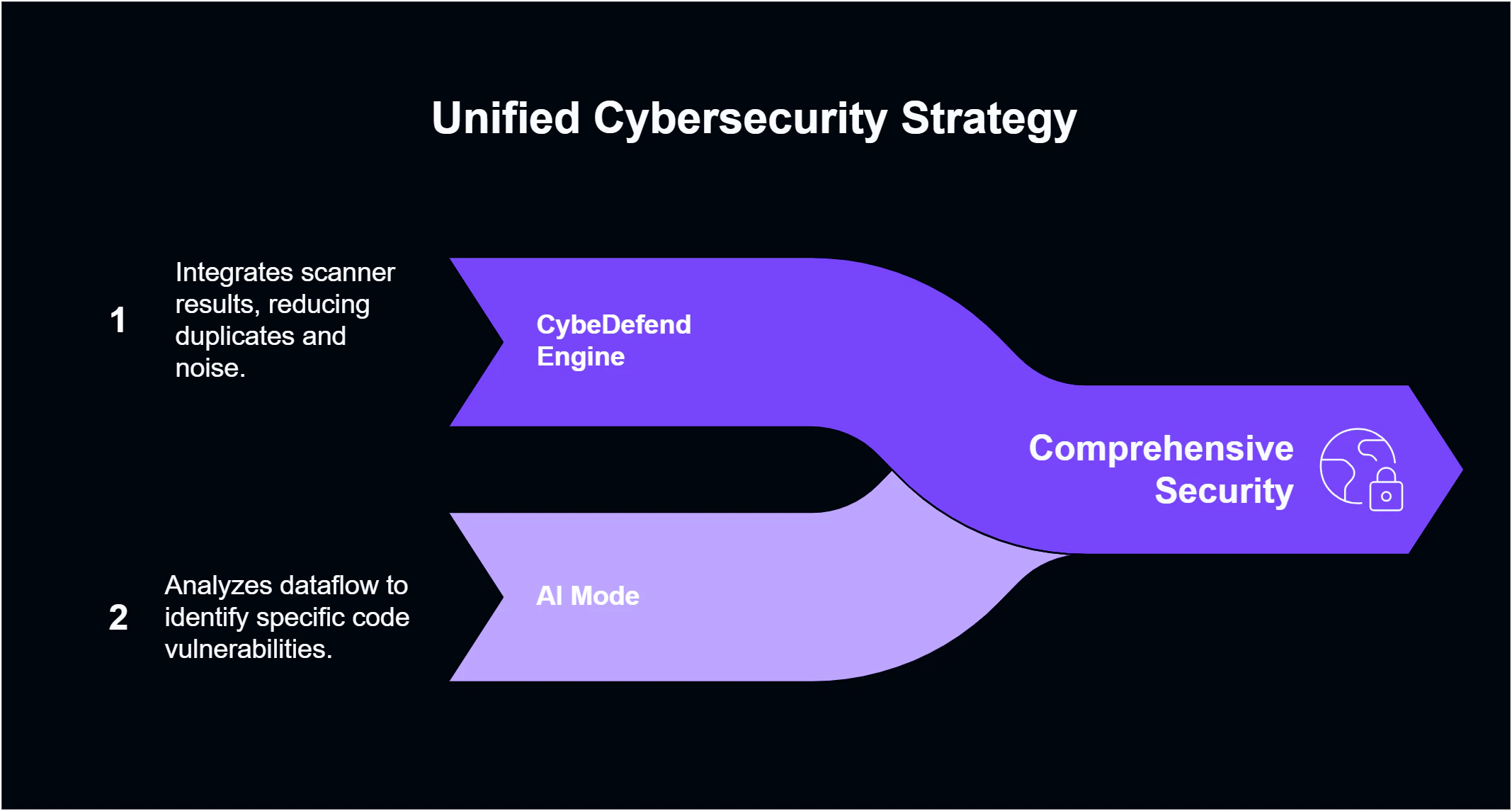
- CybeDefend Engine – Aggregates and cross-references results from multiple open-source and proprietary scanners, minimizing duplicates and noise.
Why Use CybeDefend?
- Unified Scanning: The CybeDefend Engine merges findings from different tools into a single, concise view.
- Reduced Noise: Duplicate or overlapping vulnerabilities are identified and consolidated, preventing alert overload.
1. Static Application Security Testing (SAST)
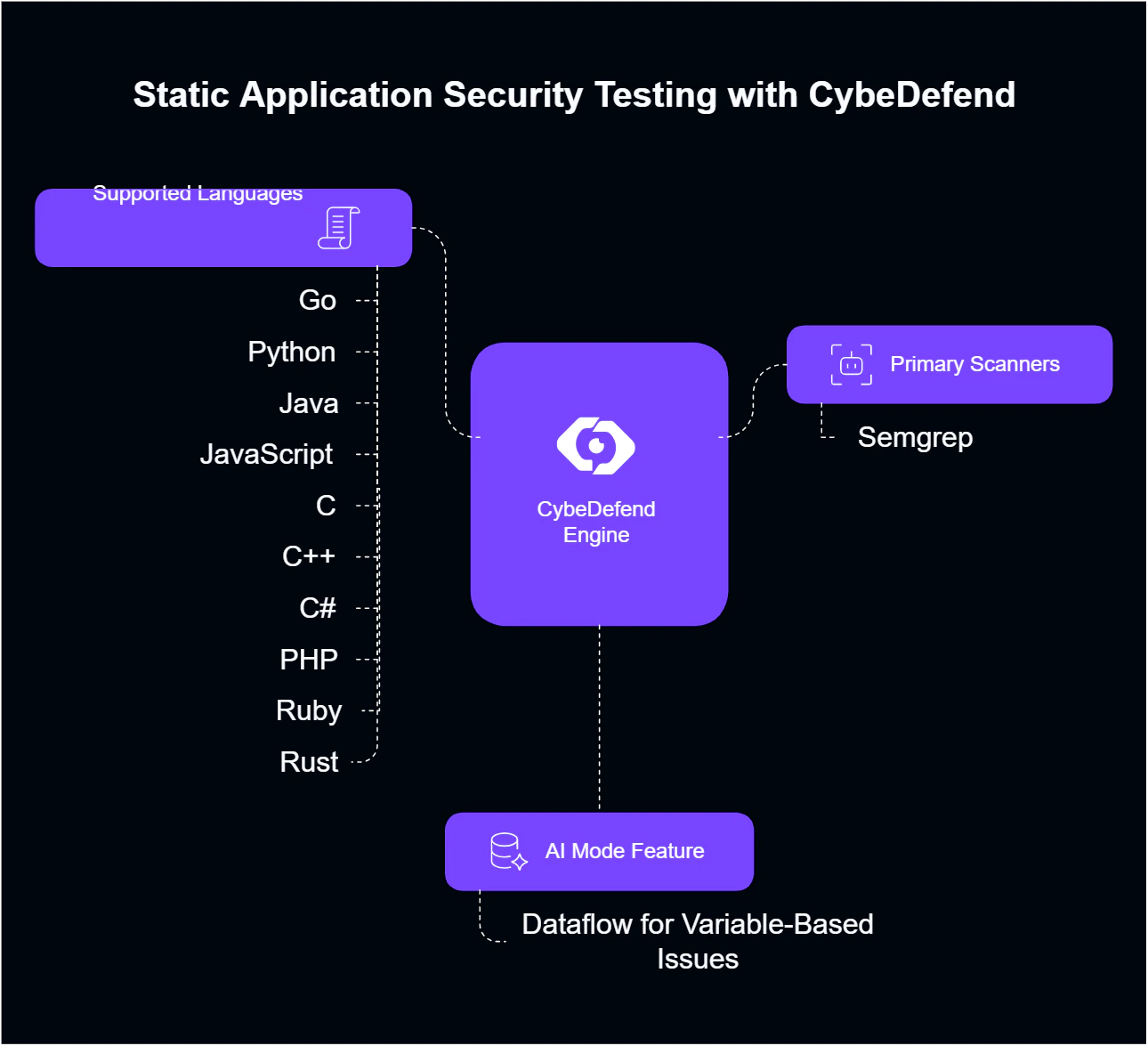
SAST inspects your source code to catch vulnerabilities early in the development process. CybeDefend unifies open-source scanners (e.g., Semgrep) under the CybeDefend Engine.Supported Languages
Rust is not supported by Opengrep — CybeDefend covers it with its own dedicated security rules, run by the CybeDefend Engine.
2. Infrastructure as Code (IAC) Security
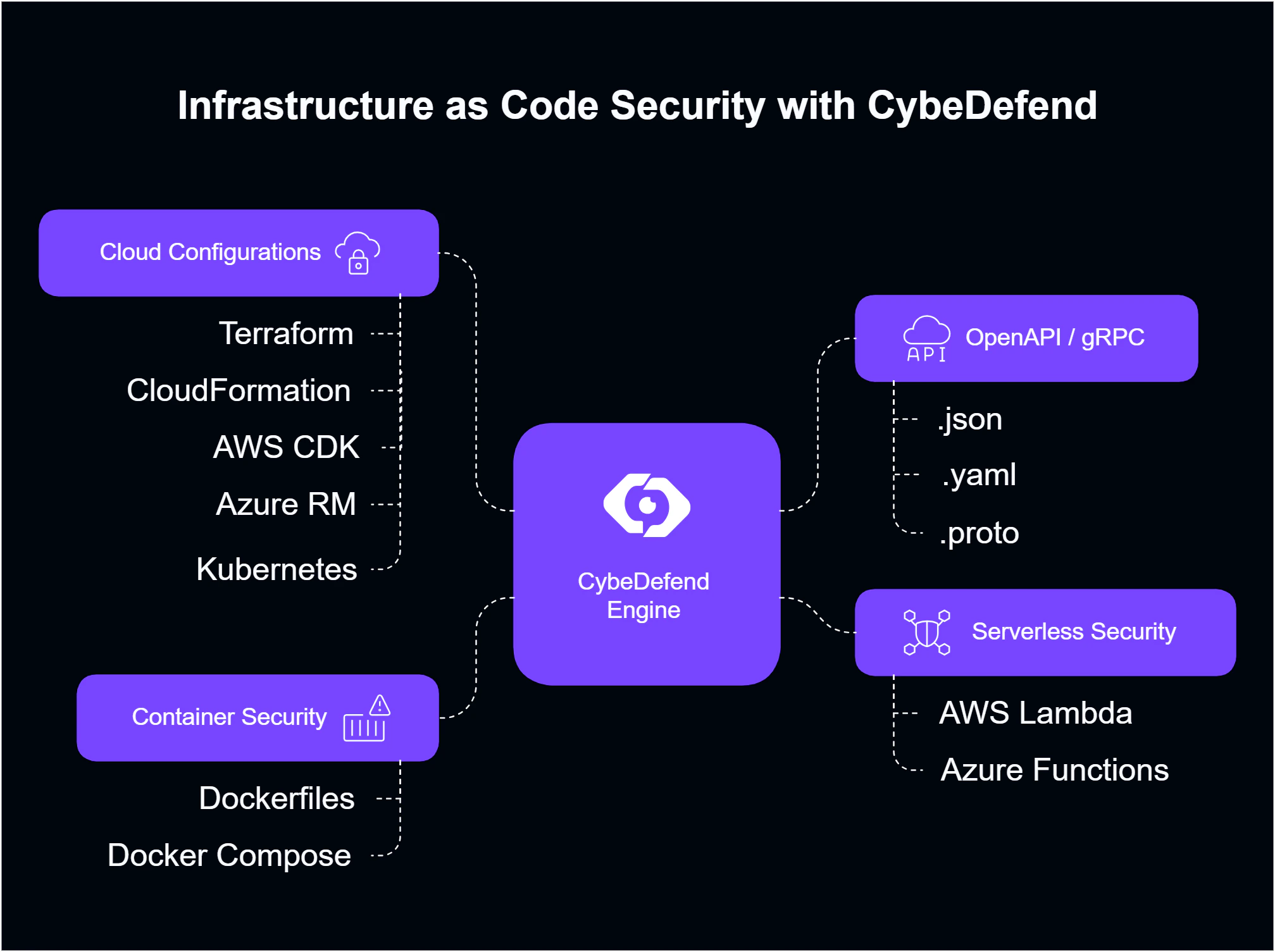
IAC scanning ensures that cloud and container configurations adhere to best practices. The CybeDefend Engine works with scanners like Checkov, Trivy, and KICS to identify misconfigurations. Unlike SAST, enabling AI Mode for IAC does not provide line-level dataflow (which is primarily for code), but the Engine still handles intelligent vulnerability matching and deduplication.Supported Technologies
3. Software Composition Analysis (SCA)
SCA detects vulnerabilities in third-party libraries and open-source dependencies. CybeDefend uses the CybeDefend Engine combined with Google OSV — the open-source vulnerability database maintained by Google — to identify known flaws in your dependencies. Rather than relying on a single feed, OSV continuously aggregates and normalizes advisories from 35+ language ecosystems and OS/distribution security trackers into one source of truth. GitHub Advisories (GHSA) is one of the many databases OSV consolidates, so earlier coverage is fully retained — and considerably expanded.SCA Scanning Tools
Vulnerability Data Sources (Google OSV)
CybeDefend draws its SCA intelligence from Google OSV (Open Source Vulnerabilities), an open, distributed database that aggregates and normalizes advisories from across the open-source world into a single schema. This spans language package registries (npm, PyPI, Maven, NuGet, Go, crates.io, RubyGems, Packagist, Hex, and more) and OS / distribution and container-image feeds (Debian, Ubuntu, Alpine, Red Hat, SUSE, Rocky Linux, Chainguard, Wolfi, and many others) — with GitHub Advisories (GHSA) folded in as just one of the contributing sources.These sources are aggregated continuously and grow every day. New advisories — and entirely new ecosystems — are added to OSV constantly, and CybeDefend ingests them on an ongoing basis, so your scans always reflect the latest known vulnerabilities with no action on your side. The counts below are a snapshot from osv.dev, July 2026 — over 767,000 advisories across 38 sources — and only trend upward. Check osv.dev for live figures.
The counts above reflect the advisory data OSV provides. Which ecosystems CybeDefend parses from your project — for dependency detection, license lookup, and exploitable paths — is listed under Feature Support by Ecosystem below.
Files & Package Managers
Below is a non-exhaustive list of key files we inspect:Files like
bun.lockb (binary Bun lockfile), .jar / .war / .ear (Java archives), and .deps.json (.NET build output) are not supported for SCA parsing. Use their text-based equivalents instead (bun.lock, pom.xml / build.gradle, packages.lock.json).Feature Support by Ecosystem
Not all ecosystems support every SCA feature. The table below shows which features are available for each ecosystem:If you use special file names or custom project layouts, you can configure file-patterns in the CybeDefend dashboard to ensure they are recognized and scanned.
4. Secret Scanning
Secret scanning detects hardcoded secrets — API keys, tokens, passwords, private keys, and other credentials — exposed in your source code. CybeDefend runs Gitleaks under the CybeDefend Engine to surface these findings alongside your SAST, SCA, and IaC results in a single view.Secret Scanning Tools
Related: Scan Parameters · Create a Project · Cybe Analysis